





I can’t remember a more difficult year, gardening wise, than this one! I have arms that stretch down to my knees, or that’s what it feels like, because I have carried countless heavy cans to keep my Daphnes, witch hazels and moisture-loving ferns alive. Or should I say, hopefully alive! You can’t water everything and (personally) I’m not a fan of irrigation systems that water things copiously whether plants need it or not. I’d rather read the signs of flagging foliage, or leaves held vertically in an effort to avoid transpiration. Vertical foliage or flagging foliage are distress signals best answered with a can of water, rather than a dribbling hose.
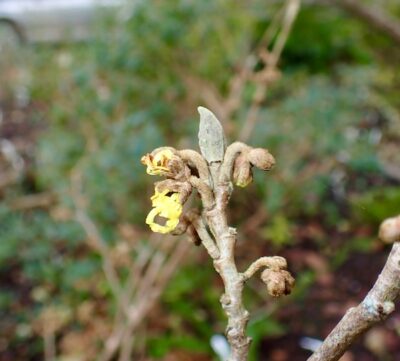
It’s interesting watching plants respond to heat and drought. My cotinus is holding its leaves upwards, like shuttlecocks. My witch hazels, or Hamamelis, turned their leaves downwards to a vertical angle as they attempt to avoid the scorching sun. Witch hazels rely on summer moisture because H. x intermedia is a hybrid between two thirsty Asian species. One parent is the Chinese witch hazel H. mollis. The other is the Japanese witch hazel H. japonica. Asian summers have a rainy season lasting six weeks and I experienced this for many years when I went to lecture at The Barakura English Garden in Japan every June. Heavy rain would drench the ground and then the sun would shine and then you’d find yourself in an outdoor sauna and steam room within seconds. Asian summers are on the dry side, so winter wet doesn’t do them any favours.
Asian plants enjoy a summer deluge, people not so much. I once witnessed an English Shakespearean theatre troupe perform The rain it raineth every day, the closing song from Twelfth Night. They were accompanied by thunderous rain and the players hammed it up and skidded about on the flooded stage, with flickering electric lights overhead. They substituted various synonyms for rain including pouring, cats and dogs, streaming, torrent and so on, with a few swear words thrown in. The Japanese audience were largely oblivious to this word play. Or were they just being inscrutable. Whatever, that scene has defined the word hysterical for me ever since.
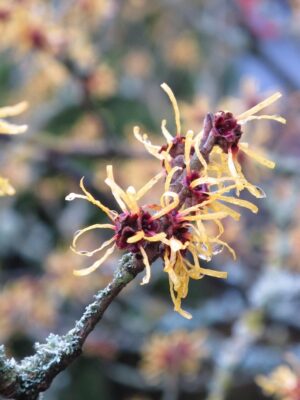
You can see why my witch hazels, and I have 14 of them in the woodland garden, needed extra water this summer. Despite my sterling efforts, they suffered damage on the last Thursday of the fifth heatwave when temperatures peaked at 37C. That day crisped and browned the foliage, Worse still, there are hardly any little fists of brown buds to be seen. Next January will probably be duller, for there will be very few marmalade-coloured spidery flowers to illuminate January and February. I will miss their scent horribly too, for the acrid-yellow ‘Pallida’ smells of freesias – even on chilly winter afternoons.
Thankfully my roses defied the heat and drought. They flowered brilliantly and their foliage was healthy and glossy and never scorched or wilted. They kept my garden going, supported by dark-leafed sedums, nepetas and marjorams. The rose’s resilience is all down to their natural provenance for many species roses, used in breeding lines, come from hot, dry places such as Persia (now known as Iran) and the Holy Land. Hence, they thrived and I’m hoping this summer might restore the nation’s love for roses, because they have been in the doldrums.
I think that’s partly due to the fear of black spot disease or Diplocarponrosae, a fungal disease that tends to appear from the second half of summer when the weather turns warm and wet. Black spot defoliates and weakens the rose and, when the foliage falls on the ground, spores land on the soil. Wet weather washes them back up again and the whole cycle starts again. Modern gardeners are eco-friendly and averse to sprays, including fungicides.
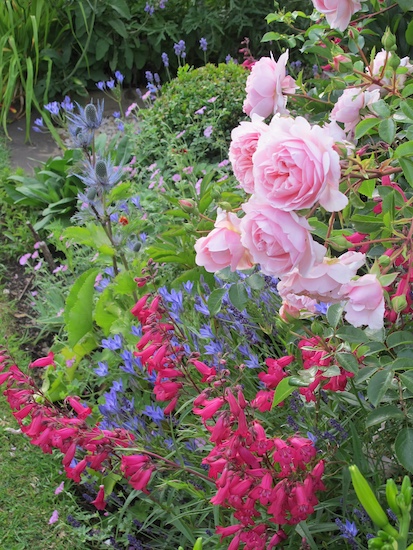
I do occasionally suffer some blackspot. As soon as I see any dodgy looking leaves I remove them before they get the chance to land on the ground. However, and it’s a big HOWEVER, lots of roses never suffer from blackspot because modern rose breeders have become better at using healthy roses in their breeding lines in recent years. Don’t put up with a sickly rose. Dig it up and put a hardy geranium in the hole straight away. Replant a healthy rose a little way away. Rose companies will happily advise you about the health of individual roses.
Newer David Austin varieties are much healthier than the older ones were. I am a big fan of ‘Olivia Rose Austin’ which was launched in 2014 from a new breeding programme. David Austin Jnr, who sadly passed away this year, named it after his daughter and that was a good indicator that he rated it. I have noted, in previous years, that Olivia hung her head and always assumed this was because it was too dry at the root. This year Olivia’s roots must have been dry, very dry, but the mid-pink flowers were upright and stayed upright with not a swoon in sight. I don’t cut off spent stems using secateurs. I nip the faded flowers off underneath, using my finger and thumb, because this encourages new shoots quickly.
All my pale-pink and mid-pink roses have done well this year. I have invested in another ‘Penelope Lively’, launched by David Austin at Chelsea in 2023. She’s a richer pink, with shades of strawberry-pink, and the smaller flowers have a classic rose scent. She’s only 3 feet high, or 90cm, and that reflects the size of most recently bred roses. They’re no longer lanky and upright as they were when I was a child. They are shorter with clusters of lightly scented flowers, so they slot into summer borders brilliantly. Penelope’s strong scent marks her out as special.
I’m a Penelope Lively fan and I used to read her children’s books to my classes in a previous life as a teacher in the Banbury area. Penelope lived in Great Rollright at that time. I would see her in the village shop at Hook Norton, hiding behind her thick glasses just as I hide behind mine. Her children’s stories were set in Oxfordshire and they included The Driftway, The Whispering Knights and The Ghost of Thomas Kempe. They were rattlingly good reads.
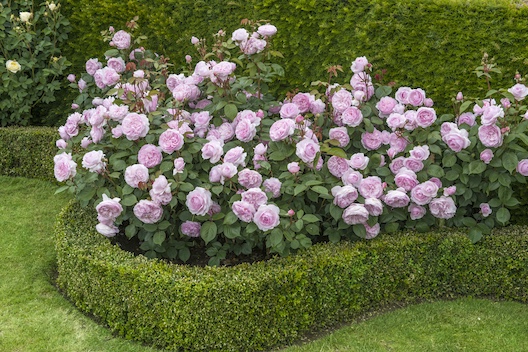
David Austin has also raised the very healthy fully-petalled pink roses ‘Wildeve’, ‘The Generous Gardener’, ‘Emma Bridgewater’. ‘Wildeve’ (2003) is suited to the back of a mixed summer border, because it can reach five feet in height, or 1.5m. ‘The Generous Gardener’ (2005) is at least five feet tall and leafy and is sold as a climber, although it does do well as a free-standing large shrub. It forms lovely hips, although the birds ignore them here, so leave the late flowers on the bush and add them to your Christmas wreath.
The more-recent ‘Emma Bridgewater’ (2024) is thorny, so it needs careful placing. It’s also a more-complex colour to place. The pink flowers deepen to coral-pink and then fade towards lilac-pink, although they didn’t fade much this year. Coral-pinks, which veer towards orange,are tricky to place and I have one excellent rose called ‘You’re Beautiful’. This year the bright sun faded the flowers to almost white, but it hangs on to its flowers for weeks and the autumn flush is richly colourful and abundant.
The deep-pink ‘Gabriel Oak’ has also been excellent this year and it’s a very pretty colour. The single striped (and much hyped) ‘The King’s Rose’ has failed to flower at all. Better luck next year perhaps, for some roses take their time to get going. If I seem to be banging on about pink roses per se, it’s because pink roses usually do well in the garden. Deep-reds and yellows tend to be weaker in growth habit.
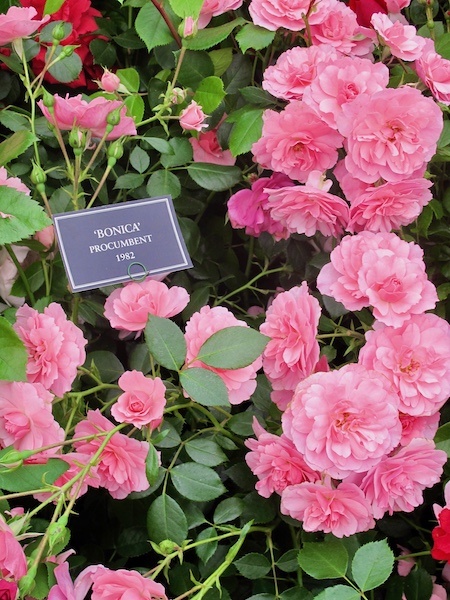
There are lots of good pinks that haven’t been raised by David Austin and one of the best is the French-bred highly popular floribunda ‘Bonica’(1981). The mid-pink flowers are held in clusters of up to twenty, if this rose is happy. They begin in July about four weeks later than most. The second flush is also later, so this is often the last rose flowering here and it often brightens up a November day. ‘Bonica’ also has a reputation for doing well on poor soil, possibly due to being bred in France.
If you’re thinking of buying roses, there are plenty of potted roses available this month because gardeners didn’t snap them during the summer heat. However, my advice is to order bare-root roses now and then plant them between November and February. They get away better than potted roses, as long as the soil is frost-free. Trevor White Roses and Peter Beales supply excellent roses.