



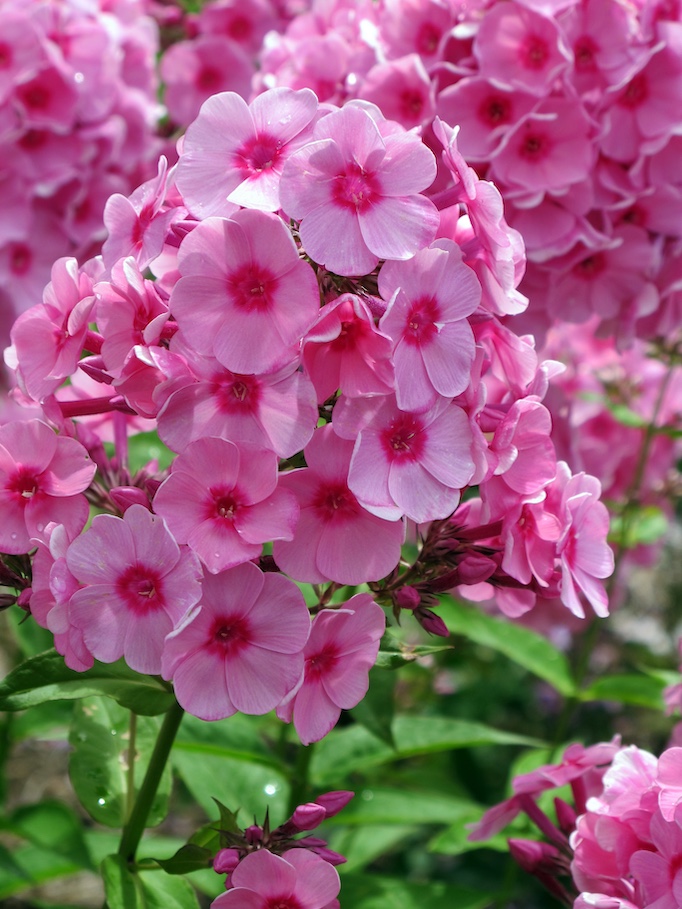
Gardening is so much more than digging holes, plonking plants in and weeding. Take fragrance for instance. It nourishes the soul and lifts the spirits and all you have to do is breathe in deeply through the nose. When I come up my garden path on. A summer’s day, I pass a mass of border phloxes full of butterflies. I have the tall cool-pink ‘Utopia’, the red-eyed pink ‘Bright Eyes’, and an unnamed mauve and pink. Admittedly they’re suffering, due to the dry summer and excessive heat, but their cake-like fragrance still wafts through the air. I love the Maderia-cake smell, but not everyone appreciates their scent. When I judged the Border Phlox trial, at RHS Wisley, my fellow judge Ray Waite detested the smell of phloxes.
Further up the path, the honeyed scent of Buddleja davidii takes over from the phloxes. It’s sustaining butterflies and hummingbird-hawkmoths on warm days and it does a brilliant job on me too. The recent heat has sent the flowers over quickly, but judicious deadheading should encourage more. It’s the most honey-scented plant of all and the best butterfly plant you could possibly grow because it could (in theory) attract over 20 British species.
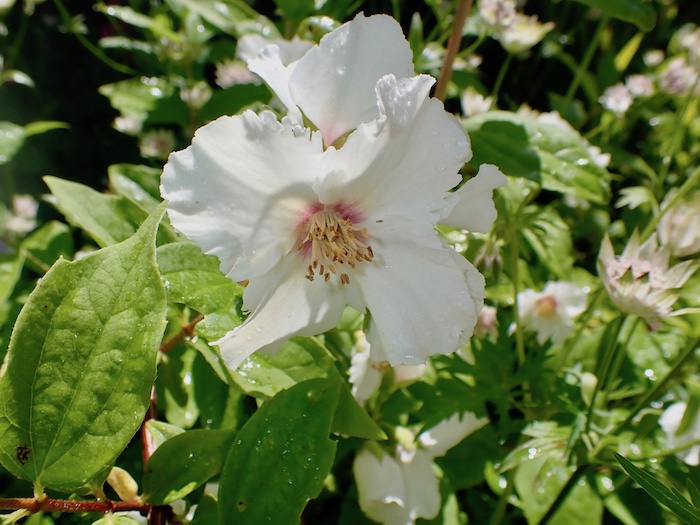
Earlier in the year, the dominant scent is citrus-lemon courtesy of Philadelphus ‘Belle Étoile’. This medium-sized mock orange has white flowers, each with a damson smudge in the middle, and it’s the best philadelphus to grow in the garden because they’re a mixed bunch. I do grow two plain whites, ‘Sybille’ and ‘Lemoinei’ but they’re not as lovely. Their common name for Philadelphus is mock orange, is slightly misleading for the scent is pure lemon. Nothing captures the fresh mood of an early summer’s day in the same way.
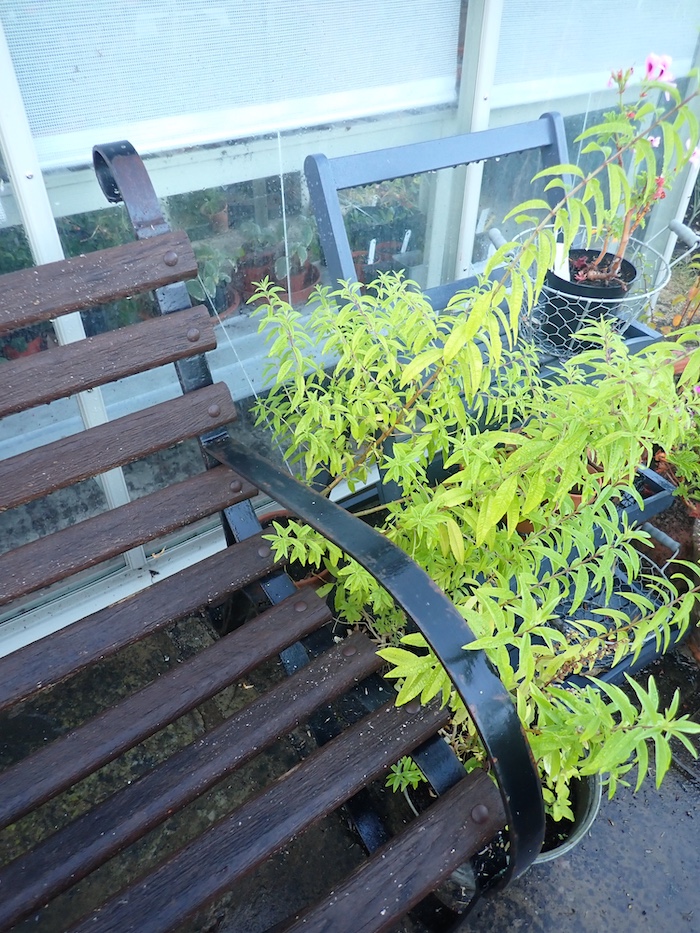
Lemon is a refreshing and reviving scent and I have pots of Lemon verbena, Aloysia citridora, by my garden seats. Rubbing my fingers through the foliage takes me straight back to childhood, when a sherbertdab with a liquorice stick was the stairway to heaven. The perfect accessory to a roller-skating dash through the local London parks. This South American plant will overwinter in an unheated greenhouse (Hartley of course) as long as it’s kept on the dry side. It will play dead, but if you start watering again in April it will soon come back to life. Take cuttings though, in case.
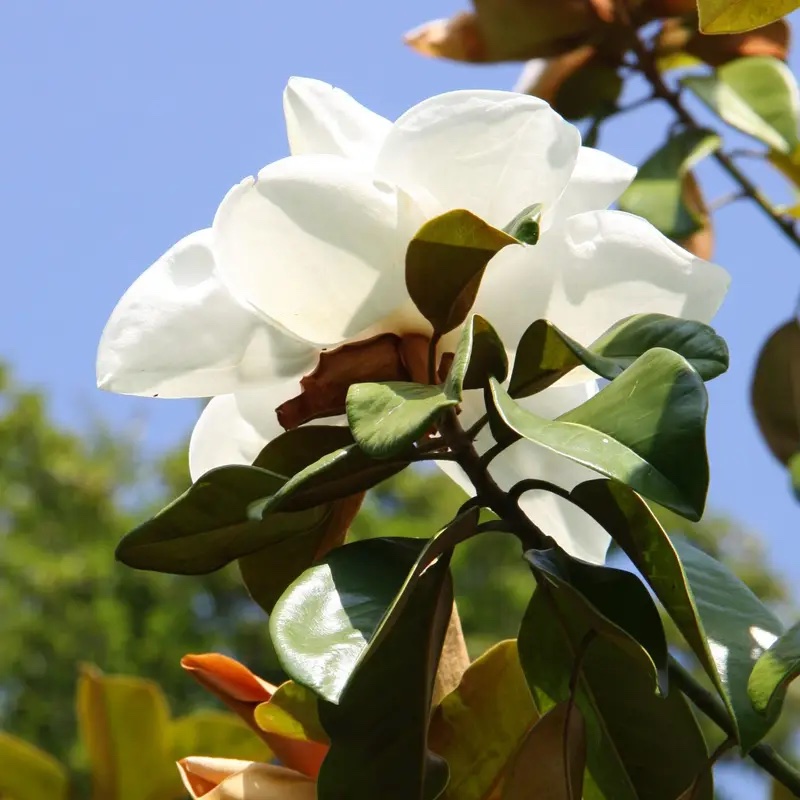
I get the same citrus buzz from a scented-leafed pelargonium called ‘Radula’. The divided foliage, thistly to the touch, exudes lemon and the leaves were used to flavour cream puddings and possets Although I haven’t ‘tried that at home’ and perhaps you shouldn’t either. The Ultimate Lemon Scent trophy should be awarded to the American native Magnolia grandiflora, named for its huge white satin-textured goblets. These are produced in the second half summer, so the flowers never get frosted, and they are backed by rounded evergreen foliage felted in brown on the undersides. The proper name for the furry underside of the leaf is indumentum.
Known as the Southern Magnolia or Bull Bay, Magnolia grandiflora isfound some 500 miles away from the Atlantic Ocean in the sunshine states of North Carolina, Florida, Texas and Arkansas. It loves the damper areas close to the Mississippi River, but it is also found on sandy dunes. It was introduced into Europe in 1720, but this large evergreen (which can reach 90ft in the wild) has a subtropical provenance and was only planted on warm walls. It is said to be hardy to -24C ( -12F) but only for short periods. It needs a sunny, sheltered position on neutral to acid soil. You often see it on sun-baked south-facing walls on grand houses with large walls to cover.
There are lots of named forms and one of the most available is ‘Exmouth’, named after the Devonshire town where Sir John Colliton grew it in the early 18th century. This seafarer collected seeds in America and returned home with them and raised some plants. Cuttings were taken from Collinson’s tree and it was layered, by bending a branch down to the ground. Others I’ve admired include ‘Goliath’, and this will flower in flushes from July until November. ‘Samuel Somner’ has saucer-shaped flowers and brown-backed glossy green leaves. It’s said to flower when young.
Magnolias are ancient plants and they evolved before bees, butterflies and wasps so their sumptuous flowers are pollinated by beetles instead. The flowers are fragrant and pollen-rich, when they open beetles consume the pollen and flower parts and spread pollen about in the process. The most popular garden magnolias were collected in China in the early years of the 20th century, often by Ernest ‘Chinese’ Wilson. At one time America and China consisted of one land mass, but when continental drift occurred some found themselves in Asia and others in America.
The warm May weather accentuated scent from a white clematis collected by Ernest ‘Chinese’ Wilson. Types of Clematis montana tend to be sweetly scented, but the true ‘Wilsonii’ has white flowers that smell of chocolate. My husband thought I had made him a chocolate cake, but I hadn’t! When buying this one, try to sniff the flowers because there are plenty of imposters labelled ‘Wilsonii’ aren’t the real McCoy. Mine is planted on the southern side of the summerhouse because Montane clematis, the species name meaning from the mountain, demand two things. That’s warmth and good drainage.
‘Wilsonii” flowers later than many named forms of Clematis montana and the white flowers are larger too. The four widely spaced ‘petals’ (actually tepals) are diagonally opposite and surround very long stamens.‘Wilsonii’ is found naturally in western Szechwan and south-east Yunnan. John Grimshaw has an excellent website. Just Google Trees and Shrubs On Line and you’ll find expert information. The website says it was the commonest form of the species in W. Szechwan. It has been described by August in Henry in 1888 and Wilson saw it in 1904. He finally collected it in 1907 for the Arnold Arboretum. Wilson introduced thirteen different clematis whilst on his travels to China. This one’s the best!
There are other chocolate-scented flowers, but I struggle to keep the tubers of Cosmos atrosanguineus from year to year. I do succeed with a dahlia named ‘Karma Choc’ and it’s one of the best I grow. The Karma Series has been bred for the cupflower marker by Aad Verwer, a Dutch breeder. ‘Karma Choc’ is the best of all of them, for the foliage is bronzed and the dark-red flowers have an almost black centre. On warm days, the chocolate scent is very noticeable. Sadly, it’s no longer available, because the breeders retired. A lot of the other dark-red ones have a chocolate scent and that includes ‘Mexican Star’ and ‘Sam Hopkins’.
Dark-red flowers often smell of chocolate and there’s even a chocolate vine, Akebia quinata. This is slow to establish and sometime in the 1980s I planted one on the front of a cottage I owned in Northamptonshire. It did very little, but when I revisited the village thirty years later it covered the entire south wall of the cottage and the dark-red clusters of flowers hung like small bunches of grapes. This native of Japan, China and Korea has spicy flowers more reminiscent of vanilla.
I have also been growing one with much longer racemes, Akebia longeracemosa. This native of central to southern China and Taiwan is spring-flowering and long. The vanilla-scented flowers are purple to red. It’s on the west-facing side of the summerhouse, but a hard winter may see it off. They’re both twiners so wires will be required.
A hardier option, should you want to waft a vanilla scent through the garden, is the evergreen Azara microphylla. This used to span the porch of my cottage, until the builders intervened and grubbed it out. The scent used to travel all over the garden on February afternoons, despite the inconspicuous and tiny yellow flowers. I still miss it!