


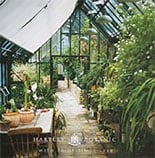

Silly gardener! Summer goes,
And winter comes with pinching toes,
When in the garden bare and brown
You must lay your barrow down.
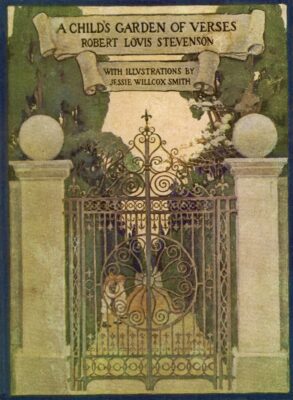
So wrote Robert Louis Stevenson in A Child’s Garden of Verses, where youth (the child) admonishes an older person (the gardener) to lay aside their chores and woes, and play while the sun still shines. Not bad advice as winter advances and garden work peters out.
I lay down my barrow today and embraced the cool crisp air and mellow colors of fading leaf and flower, and listened deliberately to the music of the landscape. Too often the scent and scene of a garden is what engages our senses at the expense of sound, distracting us from chattering squirrels as they scuttle from tree to tree, buzzing bees in the lavender, a chirruping hummingbird advancing on Salvia darcyii for its flame red trumpets, and the myriad calls of crows, doves, house martins, bluejays. But autumn allows us to sit and to listen. And to wonder what on earth sort of bird is making that racket? The garden provides many learning moments: being able to identify what you’re hearing is, to my mind, part of the enjoyment.
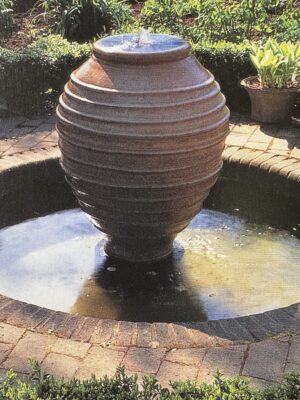
Add a water fountain to a garden and the place comes even alluring, burbling and splashing to its own erratic tune. n.b. Beware though, of an overly energetic water jet, which can sound too much like a bathtub filling, this is especially true in a small garden where mask fountains spilling a torrent from the mouth of a cement lion into a tiny basin are popular space savers. Moderation is key, and to that end I’ve had the most success with bubble fountains made in large terracotta urns. The water rises up just below the surface creating gentle ripples that spill down the sides of the urn into a retaining basin. It is calm enough for the birds to sip from, and its gentle music is perfectly attuned to soothing the spirit.
The Edwardian English industrialist, Sir George Sitwell produced with some intensity, and not a little hyperbole, a small book titled On the Making of Gardens. Writing in 1909, following a sojurn in Tuscany, Sitwell celebrated the romance of gardens, overlaid with a smattering of the new science of psychology. In 1949, his son Osbert Sitwell, wrote an introduction to a new edition, and like his father’s book, a period masterpiece of Sitwellian prose (his sister Edith and brother Sacheverall, were also writers worth enjoying, particularly the later who was a great gardener with a special fondness for antique roses. (But I digress). Osbert, critiquing his father’s book, observed that although Sir George often bit off more than his journalistic abilities could chew, yet conceded that while he was “adept at taking hold of the wrong end of a thousand sticks, yet when by chance he seized the right end, his grasp of it was remarkable”, the result being On the Making of Gardens.
Reading it today, the dense prose style makes it more of a hike through the weeds than a ramble down a garden path. However, the page devoted to ‘Sounds in the Garden’, explains that “the peaceful murmur of a pond placed at the climax of the scene may heighten its prevailing note, the rush of water will give life… . Other sounds and the stirring of other senses—the warbling of birds, the sighing of the wind in the tree-tops…the perfumes of free-scented flowers, the soft springy turf, warm sun and breaths of vagrant air – each of these has its share in building up the impression we receive.”

Wrapping up his thesis, Sir Osbert declared, “..beauty rouses emotion, emotion unlocks the door to imagination, which is set free to wander in a world of dreams…”. Nowhere, he advised, is this more true than in a garden.
Who wouldn’t agree with that?