





You might think of Simon Cowell when I mention the X Factor, but I’m talking about hybrids that arise when two plants hybridise. Usually, it’s the bees that do all the work. They travel between flowers searching for nectar for energy and protein-rich pollen for breeding. As they go, they accidentally transfer pollen from one flower to another. If the pollen is fertile, seeds are set. The seedlings have more vigour than the parents if two different species are involved.
Hybrid vigour is very important in the plant world and that includes snowdrops. As many of you may know, I’m a galanthophile. There are over twenty species of Galanthus, the Latin name for snowdrop meaning milk flower. None are native to Britain, but four different species make their way into gardens regularly.
The most commonly one found in gardens and churchyards is Galanthus nivalis. This short, diminutive snowdrop has grassy foliage and it flowers in February so it sometimes knows as the Fair Maid of February. There are single and double forms. It’s worth mentioning that the doubles always look open, even on dull days, so they make much more of a show. Single-flowered forms only open in bright light, although they are purer in form.
Some nivalis colonies must be hundreds of years old and it’s probably because the bulbs were used medicinally. It’s found in churchyards and monasteries and one of the best ecclesiastical places to visit is Welford Park in the Lambourn Valley in Berkshire. These days this ruined monastery is better known as the home the Great British Bake Off. However, it opens for snowdrops every day from the end of January through to 1st March. This snowdrop prefers a woodland situation and most of the snowdrops at Welford Park grow under hazels planted along the chalk stream. Wellies are needed!
Galanthus nivalis was often used to decorate altars at Candlemas, a Christian festival marked on 2nd February in honour of the purification of Mary and the presentation of Jesus to the Temple. Candlemas was pinned on to a much older Pagan festival called Imbolc, because the date marks the midway point between the winter solstice and the spring equinox. Imbolc signalled the beginning of spring.
Three more species of snowdrop are grown widely in British gardens. Galanthus plicatus arrived here in the 17th century and the name plicatus means pleated. The wide green leaves have a small pleat at the base of the leaf and the foliage also has a pale greyish stripe down the middle. The pleat’s at the back. G. plicatus is native to The Crimea and many soldiers brought bulbs back to Britain after the Crimean War, which ended in 1856. The fuller rounder flowers often have a seersucker texture to the petals. ‘Wendy’ Gold’, which was found on Wandlebury Ring near Cambridge, has yellow flowers and it’s been generous with its pollen.
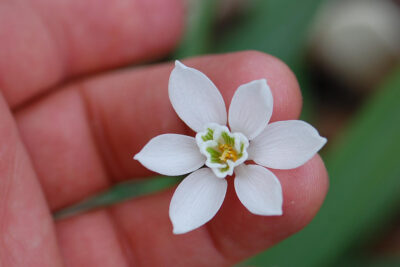
Galanthus elwesii, found in a wide area that includes Bosnia, Bulgaria, Greece, Serbia, Moldova, Ukraine and Turkey, was identified and named by Henry John Elwes in Turkey in 1874. The greyer foliage has rounded blunt ends and this snowdrop will grow in brighter positions, as many greyer-leafed plants do. I grow many under roses. ‘Godfrey Owen’ is the one to go for, because the six-petalled flowers open like Tiffany lamps. It was found in a churchyard in Shropshire. Another stroke of magic by the bees.
You’ll also find a small, bright-green-leafed snowdrop name G. woronowii, from north-east Turkey, west and central Caucasus. I have to find shady sheltered places for this and, even then, it can be very short on flower. It’s in lots of garden centres and I suspect it might be being illegally lifted from wild sites. Cider with Rosie’, found by perry maker Kevin Minchew in a Gloucestershire garden centre, has green-tipped flowers.
By the mid-20th century some gardens and churchyards contained a mix of two or three species and one, Galanthus plicatus, produces a lot of fertile pollen. When two species cross, following out pollination by early flying bees, they produce hybrids and these are more vigorous than the parents. This happens in wild colonies as well as gardens.
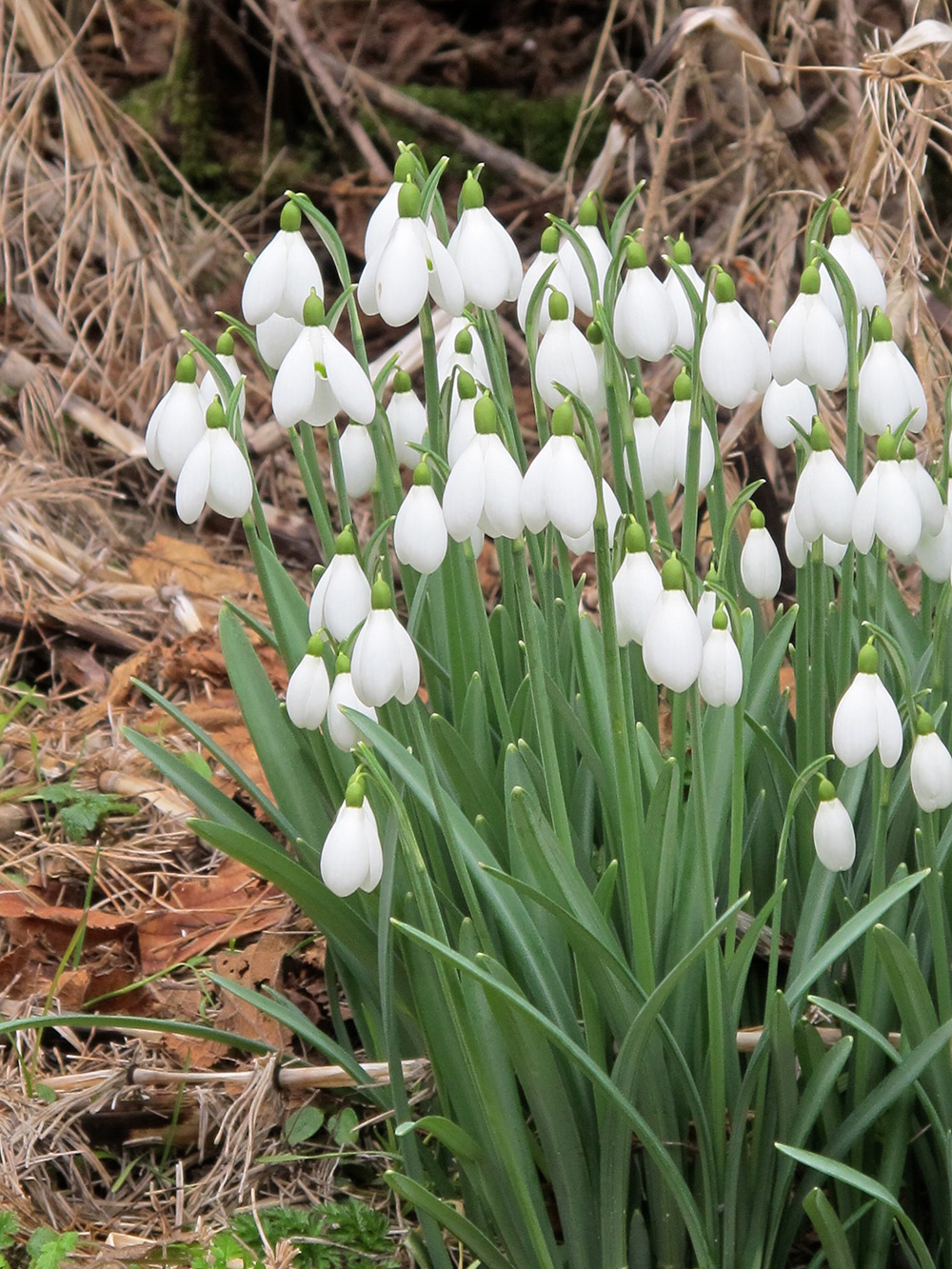
One of the most well-known natural snowdrop hybrids is thought to be the honey-scented ‘S.Arnott’. It’s named after the Samuel Arnott who gardened on the Solway Firth in Scotland. We know he distributed bulbs to Henry John Elwes and others and Henry’s ancestral home, Colesbourne Park in Gloucestershire, has an Arnott bank and, on a warm day, there’s a lovely sweet scent in the air. It’s another great snowdrop garden.
Many of the easiest, showiest snowdrops are hybrids between these commonly grown species. On rare occasions the hybrids are sterile, so don’t produce seeds. ‘Magnet’, an old James Allen seedling, produces offsets instead so it makes good clumps. The flowers dangle so it seems to dance and sway. James Allen (1830-1906) of Shepton Mallet allowed the bees to do the work for him and then selected seedlings. ‘Merlin’, ‘Galatea’ and ‘Robin Hood’ were also named by him. An RHS article, written by him, credits the bees. Very few snowdrops have been deliberately bred, using plant breeding techniques.
However, the main thing about snowdrop seedlings is the variation of form and colour. There are yellow-flowered forms, such as ‘Treasure Island’, and green-flowered forms, such as ‘Green Tear’. The inner marks vary and names like ‘Grumpy’ and ‘Two Eyes’ reflect the markings.
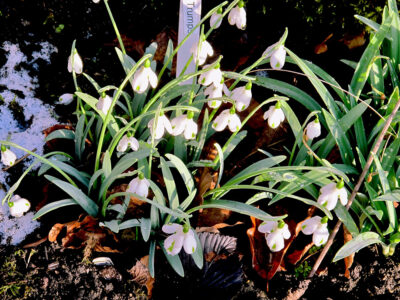
These hybrid snowdrops have enclosed by single speech marks. G. plicatus produced a pixie-hatted snowdrop named ‘Trym’ and this has given rise to many including the astonishing ‘Trumps’. Others include ‘Trymposter’, ‘Trym Baby’ and ‘Trymlet’. Too many have been named, but ‘Trumps’ is the one to get! The strong growers come down in price, because they bulk up well and you don’t lose them.
I never deadhead my snowdrops because I want variety and I am getting interesting seedlings in my garden. However, many hybrid hellebores, Helleborus x hybridus, are deliberately bred using traditional plant-breeding methods. They come in a range of colours and flower types, because there are twenty or so hellebore species found in alkaline areas of the Northern hemisphere. Many of the species are extremely difficult to grow in the garden.
These deliberately bred hellebores have always been expensive, because they don’t divide easily. Commercial production relies on producing plants from seeds. Should you allow your prized hellebore to produce seeds, it may weaken the plant and the offspring will not resemble the parent or be as good. Deadheading is advisable, because it preservef the plant and prevents inferior appearing.
Hybrids can be identified by their names in two ways. If two species are crossed there’s normally an x in the middle of the name. Many of these crosses have occurred due to pollinators and a prime example is Hamamelis, or the witch hazel. These early-flowering shrubs have ribbon-like flowers and they occur naturally in North America and Asia. When Asian witch hazels were collected and grown on at the Arnold Arboretum in Massachusetts, Hamamelis mollis from China crossed with Hamamelis japonica unbeknown to the gardeners.
Seven seedlings were planted out and the most superior had larger flowers for longer. It was eventually named ‘Arnold Promise’ in 1980. I have 14 hybrid witch hazels in my garden and they are all named forms of H. x intermedia. My favourite, the sulphur-yellow ‘Pallida’, was found on Battlestone Hill at RHS Wisley in 1958. It was probably a spontaneous seedling. Witch hazels produce seeds, although I take the nut-like seed cases off, because you get more flowers.
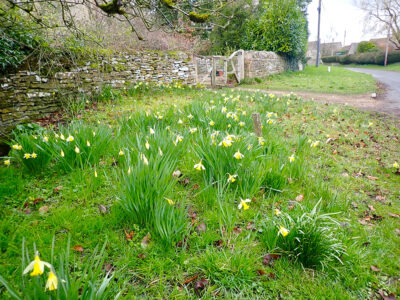
That brings me to narcissus, or daffodils. They are very highly-bred and most of the ones we grow are hybrids and they have the name Narcissus followed by a name in single speech marks. Narcissus ‘Jet Fire’ is an example. The classic advice with daffodils is to deadhead them, because they are hybrids so the seeds will not come true to type. The advantage, to the professional bulb raiser, is their ability to bulk up by producing offsets due to their hybrid vigour. They should be deadheaded.
However, species narcissus also find their way into our gardens and they include Narcissus cyclamineus, a diminutive narcissus with swept-back outer petals. Gardeners are also growing our native daffodil N. pseudonarcissus subsp. pseudonarcissus. It’s a mouthful, but this wild-looking narcissus has wispy flowers that combine pallid-yellow outers that fall forward over a slender brighter yellow trumpet.
These two species do not have hybrid vigour, so they don’t produce offsets quickly. They spread by setting seeds, following cross fertilization. Seedlings take an average of 4 – 5 years to flower and the bulbs are expensive for this reason. If you deadhead these two species they won’t spread at all. The same is true of winter aconites (Eranthis hyemalis), Scilla siberica and species tulips.
Species bulbs have Latin names and there are no single speech marks round another name in most cases. They need planting in places that get spring sunshine, to encourage the pollinators and to increase nectar flow. However, they need shading in summer. My best colony of winter aconites is under a pear tree and I try not to disturb that area. At the moment I’m waiting for my first yellow globe to appear.