




You can grow a most beautiful plant in your greenhouse or conservatory that’s so valuable just a tiny dried piece was said to be worth more than its weight in Gold. This, The Saffron Crocus, has from Ancient times been revered as flavouring, colouring and medicine. (With astronomic rises in Gold prices this no longer remains true though until recent years a gram of the purest of each was comparable.)
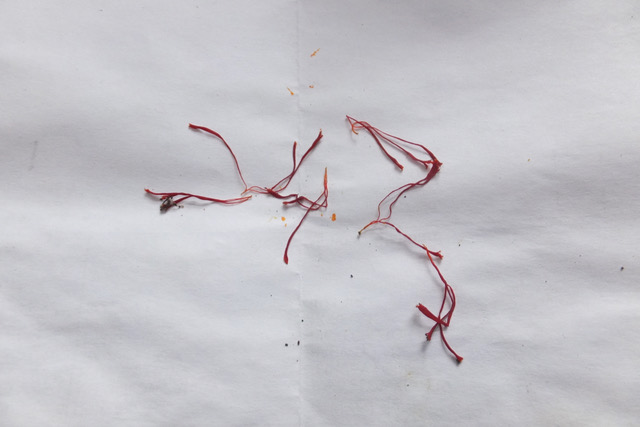
Crocus species are most known for flowering in spring however this is an autumn bloomer. The bulbs send up leaves in September soon followed by the flowers. They’re hardy so actually do not need to be kept under cover but doing so is sensible, especially if you want to harvest your precious Saffron. The delicate scented flowers first open at night and attract slugs faster than fat lettuce. Some believe their bulbs never flowered! In open ground the leaves don’t last much longer. Growing C. sativus in containers under cover enables (near) freedom from slugs and a beautiful though short floral display. (Nip those super-long stigmas off to dry as soon as fully lengthened.)
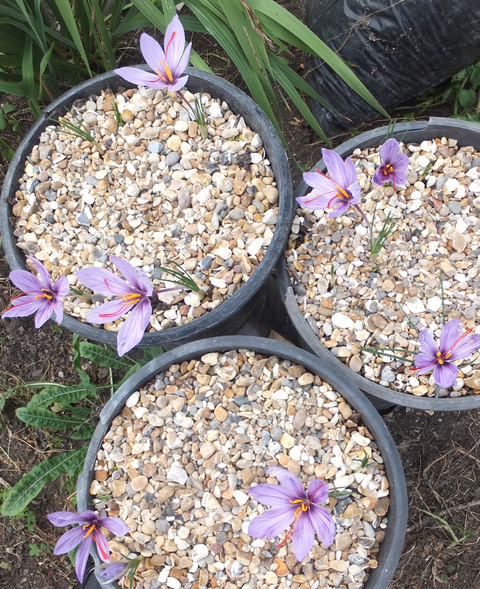
Coming from the Mediterranean region Saffron expects a cold winter then a hot dry spring and summer when the leaves die back to re-appear in autumn. Thus Saffron is suited to an unheated greenhouse or even a cold frame (though this will need be inspected for slugs, regularly!). In a heated greenhouse move the plants to a cool bright position after flowering.
You cannot start Saffron from seed, none is ever set, but the bulbs multiply so can be divided and replanted, ideally when dormant. Sometimes you can buy plants in the green in pots during winter, it’s better, well less expensive, to pre-order bulbs to plant before the end of summer.
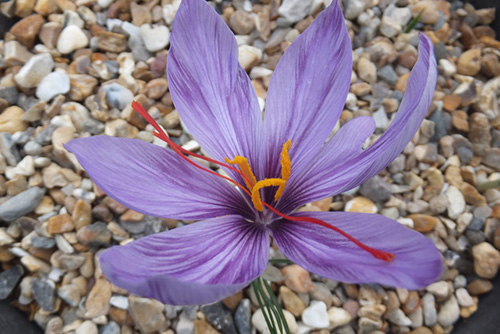
Use a rich, well drained, gritty compost kept slightly moist but never wet nor waterlogged. Plant 2-3inches/5-8cm deep and at least the same or more apart. Top off with coarse horticultural grit, this looks nice, keeps the flowers clean and helps discourage those slugs. (Even under cover they’ll seek your Saffron out, be warned.)
For the collector there are two purely ornamental varieties available C. sativus varieties cartwrightianus and cashmirianus.